By Lewis Nibbelin, Contributing Writer, Triple-I
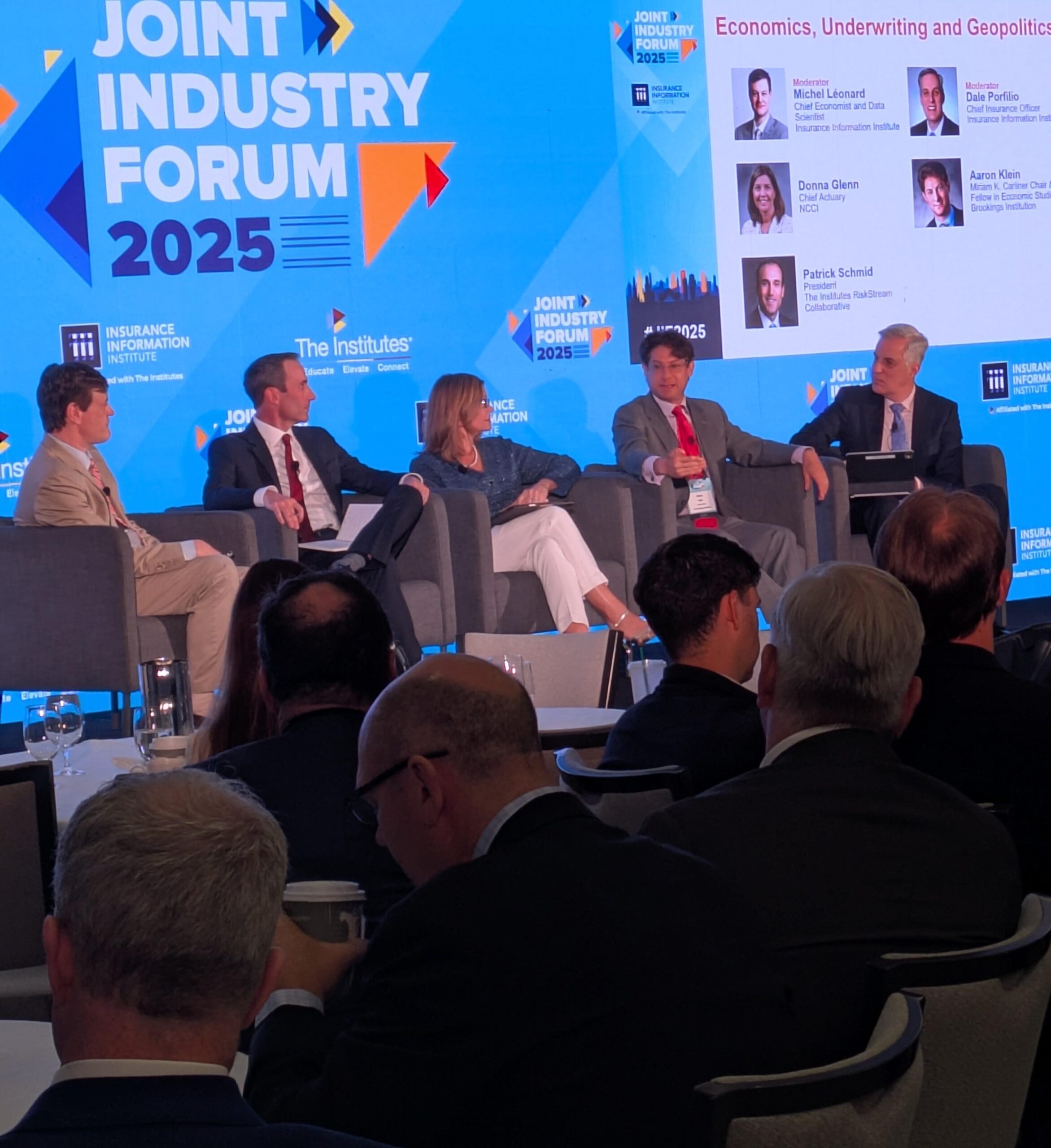
Global economic uncertainty emerging from recent U.S. policy actions was a major concern for thought leaders on the ā€œEconomics, Underwriting, and Geopoliticsā€ panel at Triple-Iā€™s Joint Industry Forum in Chicago.
Despite recently posting its most favorable underwriting performance since 2013, the property/casualty insurance industry faces several obstacles to continued progress, particularly from tariffs issued by the Trump Administration.
Short-term economic impacts
ā€œTariffs aren’t inherently good or bad,ā€ said Triple-I Chief Economist and Data Scientist Dr. Michel LĆ©onard, who co-moderated the discussion. ā€œWhere there is consensus among economists is that, in the short term, tariffs do lead to inflation and disruption.ā€
Put simply, tariffs can raise revenue for the issuing government while costing the domestic businesses that rely on imported goods. In advance of pending tariffs, companies up and down the supply chain are purchasing such goods at a , which boosts the demand and prices of these materials. Consumers will inevitably shoulder some or all of the added cost.
Many proposed or enacted tariffs involve materials essential to construction and auto manufacturing. Earlier this month, for instance, the administration its new steel and aluminum tariff to 50 percent ā€“ including on Canada, the largest steel supplier to the United States. P/C replacement costs will likely rise throughout the industry, leading to higher claim payouts and, consequently, premium rates.
Amid various tariff reductions, increases, impositions, and pauses, President Trumpā€™s trade policies remain difficult to determine or predict. This lingering ambiguity ā€“ paired with impending replacement cost increases ā€“ creates a ā€œdouble whammyā€ for insurers, said Aaron Klein, Miriam K. Carliner Chair and senior fellow in Economic Studies at the Brookings Institution.
ā€œOther markets can adapt to that more quickly,ā€ Klein said. ā€œWhen I renew my auto policy in February, the insurer on the other side has to guess what the costs are going to be over six months.ā€
While in a period of extraordinary performance, the workers compensation line also faces potential risks from oncoming tariffs, noted Donna Glenn, chief actuary at the National Council on Compensation Ā鶹Éē (NCCI). Mitigated by investments in technology and safety, workplace incidents could rise, she explained, as ā€œa lot of the uncertainty puts businesses back in a defensive mode and asking, ā€˜how should I spend my money?ā€™ā€
ā€œI caution and say there will be some temporary lack of investment in safety,ā€ Glenn continued.
Talent and technology
An evolving workforce poses additional risks.
ā€œWorkers comp has benefited from a very strong labor market,ā€ Glenn said, pointing to consistently low U.S. unemployment rates, but current mass deportation efforts could undermine this trend. ā€œWe are accustomed to having a significant influx of foreign-born workers,ā€ Glenn explained. ā€œWhen we don’t ā€“ and when we shift to not having them ā€“ the labor market could stifle to some degree.ā€
Bridging the talent gap lends further urgency to this issue, as roughly 400,000 workers are projected to leave the insurance industry through attrition by 2026 in the U.S. alone, according to the U.S. Bureau of Labor Statistics. And with generative AI automating more processes across the insurance value chain, cultivating a workforce possessing the necessary skillset to oversee them compounds the problem.
ā€œAI can certainly help improve productivity,ā€ said Triple-I Chief Ā鶹Éē Officer and co-moderator Dale Porfilio, ā€œbut we’re going to need people to do an awful lot of those jobs. Weā€™re still going to have that talent gap.ā€
Embracing advanced technology, then, gives insurers an opportunity to both develop that expertise and rebuild the workforce by attracting younger tech professionals who might otherwise overlook the industry. Innovative companies like Argo Group are already paving the way for this collaboration.
Patrick Schmid, president of The Institutesā€™ RiskStream Collaborative, acknowledged that ā€œgetting clarity about how significantly you can leverage AI is very important.ā€
Concern about using AI in underwriting, Schmid said, given an absence of AI regulatory guidance, which does not exist federally and is on a state level.
To provide insight into these efficiencies, Schmid described how RiskStream ā€“ a consortium of insurers, brokers, reinsurers, and other industry leaders ā€“ applies AI to streamline data processing, lower operating costs, and enhance customer experiences. Beyond expediting business operations, AI offers potential solutions to a range of challenges plaguing insurers, Schmid said ā€“ including that might help mitigate legal system abuse by facilitating earlier claims intervention, preventing excessive attorney involvement.
The panelists agreed that insurers will continue to adapt their underwriting and pricing to reflect this dynamic environment and emphasized the economyā€™s strong, steady recovery post-COVID.
ā€œThere’s not been a single case of an economic expansion in recorded history dying of old age,ā€ Klein said. ā€œAre we near the tipping point? I donā€™t think so.ā€
Learn More:
JIF 2025: Litigation Trends, Artificial Intelligence Take Center Stage
Ā鶹Éē Affordability, Availability Demand Collaboration, Innovation
P/C Ā鶹Éē Achieves Best Results Since 2013; Wildfire Losses, Tariffs Threaten 2025 Prospects
Tariff Uncertainty May Strain Ā鶹Éē Markets, Challenge Affordability
Reining in Third-Party Litigation Funding Gains Traction Nationwide
Claims Volume Up 36% in 2024; Climate, Costs, Litigation Drive Trend